
Resolution 82/NQ-CP: A ‘Golden Opportunity’ for Vietnam’s Industrial Breakthrough
Resolution 82/NQ-CP on the development of key industries marks a significant shift in Vietnam’s industrial policy mindset, signaling a more strategic and long-term approach to economic growth.
Strengthening Domestic Capabilities
The resolution focuses on two core pillars: promoting domestic manufacturing of key industrial products and developing supporting industries. This dual focus directly addresses one of the economy’s fundamental bottlenecks—enhancing internal capabilities and increasing value within the production chain.
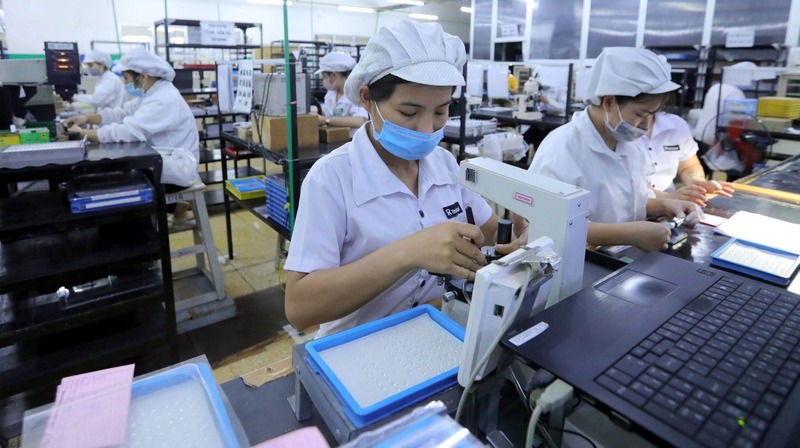
Developing a Law on Key Industries will create space for the development of Vietnam's industrial sector. (Illustrative image)
This direction closely mirrors the successful development paths of East Asian economies such as Japan, South Korea, and China. Japan achieved rapid industrial growth by selecting the right strategic sectors and committing to long-term investment. South Korea built leading conglomerates like Samsung and Hyundai, creating powerful industrial ecosystems. Meanwhile, China leveraged its market scale and strong policy support to develop large industrial clusters and gradually move up the value chain.
Today, Vietnam stands at an unprecedentedly favorable juncture. The global supply chain shift under the “China +1” strategy, combined with rising investments in high-tech industries, green transformation, and global economic restructuring, is opening a clear window of opportunity. Vietnam is no longer just a manufacturing destination but is increasingly becoming a key node in regional industrial networks.
In fact, the foundation for breakthrough growth is already in place. The presence of major corporations such as Samsung and Intel has not only boosted export value but also fostered a deeper industrial ecosystem. This serves as a launchpad for Vietnamese enterprises to move into higher value-added segments—if leveraged effectively.

The Law on Key Industries holds strategic significance for the development of Vietnam's industrial sector and economy. (Illustrative image)
A 10-Year Strategic Outlook
Looking ahead over the next decade, Vietnam is well-positioned to prioritize four key sectors:
- Electronics and semiconductors (especially in packaging, testing, and components)
- Battery production and the electric vehicle ecosystem
- Precision engineering and automation
- Energy equipment, particularly renewable energy
These sectors align with global trends and have strong spillover effects across the broader economy.
More importantly, in the short term (3–5 years), Vietnam can achieve rapid and tangible progress by focusing on the right segments. Electronics and semiconductors—particularly in midstream stages—present the most immediate opportunity, given the country’s existing manufacturing base and market access. At the same time, supporting industries, especially precision engineering, offer significant growth potential as demand for locally produced components rises.
Concrete Opportunities for Businesses
At the enterprise level, opportunities are both practical and accessible. Business models such as:
- Precision machining (CNC)
- Engineering plastics manufacturing
- Surface treatment
- Factory technical services
- Industrial material supply
serve as realistic entry points for Vietnamese firms to integrate into global value chains. While these sectors may not appear glamorous, they form the backbone of sustainable growth, allowing companies to build capabilities, credibility, and long-term stability.
From Policy Direction to Execution
To fully capitalize on these opportunities, policies must go beyond encouragement and create strong, actionable incentives. This includes linking incentives to measurable criteria such as localization rates, technology transfer, and the development of domestic suppliers.
At the same time, nurturing leading domestic enterprises and strengthening linkages between FDI firms and local businesses will be critical.
A Turning Point for Industrial Transformation
Overall, Resolution 82/NQ-CP is more than just a policy document—it is a clear signal that Vietnam is ready to enter a new phase of development focused on improving the quality of growth.
If leveraged effectively, Vietnam has the potential to transform from a “manufacturing hub” into a truly competitive industrial economy. The opportunity is clear, and the foundation is already in place. What remains is consistent execution and strong commitment.
If achieved, the next decade could mark a significant leap for Vietnam in the global industrial value chain.